
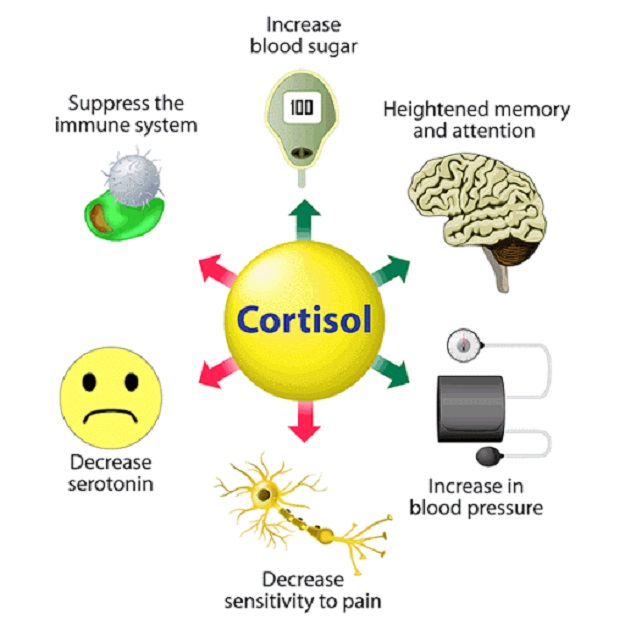
Chronic cortisolemia leads to insulin resistance and DM2 First by hyperglycemia Second through muscle wasting that leads to visceral fat.
COVID-19 is an emerging, rapidly evolving situation.
Get the latest public health information from CDC: https://www.coronavirus.gov .
Get the latest research from NIH: https://www.nih.gov/coronavirus.
Find NCBI SARS-CoV-2 literature, sequence, and clinical content: https://www.ncbi.nlm.nih.gov/sars-cov-2/.

 Dra. Martha Andrea Castro Noriega, MD
There’s bad stress and good stress!?
I worked for 16 years as a USAF Weather Observer/Weather Officer: stressful indeed!
When I left the USAF I became a Computer Programmer/Consultant mostly at the US State Department developing, managing, programming, whatever; for 25 yeas; with teams from 6 to 50+, driving 150+ miles round-trip from northern MD, 5 – 7 days a week and working 9 – 10 hours a day. My doctors couldn’t understand how I handled the stress, especially with my heart conditions.
It was not Nature but Nurture that got me through it all, in my opinion!
Me gustaLe gusta a 3 personas
Excellent information overall in your post!
Me gustaLe gusta a 1 persona
«There’s bad stress and good stress!?» Absolutely.Our bodies need cortisol to survive.
Cortisol is best known for producing the “fight or flight” response. This reaction evolved as a means of survival, enabling people to react to what could be a life-threatening situation.
The change in hormones and physiological responses forces us to either face the threat or leave it behind..
Too much, though, and we overreact to common stressors like heavy traffic, speaking in front of a group of people, or having an argument with a spouse. Over time, these out-of-control stressors compromise our health.
Me gustaLe gusta a 9 personas
Have experienced all the negatives in spades for years with no real impact except a minor stroke recently: I have A-Fib!
Also Bipolar?
Me gustaMe gusta
I explain my students these different reactions with all hormones. An excellent way to start them on physiopathology. What do you think, doc?
Me gustaLe gusta a 2 personas
Excellent presentation, Dr. Castro.
Me gustaLe gusta a 5 personas
I agree!
Me gustaLe gusta a 1 persona
Thank you, Vero, I sent you an assay to your email.
Me gustaLe gusta a 1 persona
Thank you, Dr. Martha C.
Me gustaLe gusta a 1 persona
My pleasure, Sandrie.
Me gustaLe gusta a 1 persona
I wanted to add this, Prof. Castro, MD for your consideration and valuable opinion.
Hyper- and hypofunction of the adrenal cortex (Morbus Cushing and Morbus Addison) may also be responsible for increased or decreased cortisol concentrations. Possibly, interferences of the hypothalamus or the pituitary gland, e.g. by a tumor, cause the adrenal dysfunction.
Me gustaLe gusta a 4 personas
Very very interesting, Doctor. That is exactly what I want; critical thinking, Congratulations!
Me gustaLe gusta a 1 persona
Toujours aussi informatif, intéressant !
Merci !
Me gustaLe gusta a 4 personas
Merci beaucoup
Heureux d’aider!
Me gustaLe gusta a 2 personas
Great info…And thanks for visiting my blog site…
Me gustaLe gusta a 2 personas
You’re welcome, thank you too.
Me gustaLe gusta a 1 persona
I had the honor to assist to your neurodermatitis conference. Thank you for keep on teaching science, Dr. Castro
Me gustaLe gusta a 2 personas
Her kast one on COVID.19 was oustanding,
Me gustaMe gusta
Isn’t Dr. Castro great? She’s my mentor!
Me gustaMe gusta
😉😁😁😁
Me gustaMe gusta
Reblogged this on Intellect | Adventure | Nobility.
Me gustaMe gusta